
5 Signs Your AC Needs Immediate Repair in the UAE
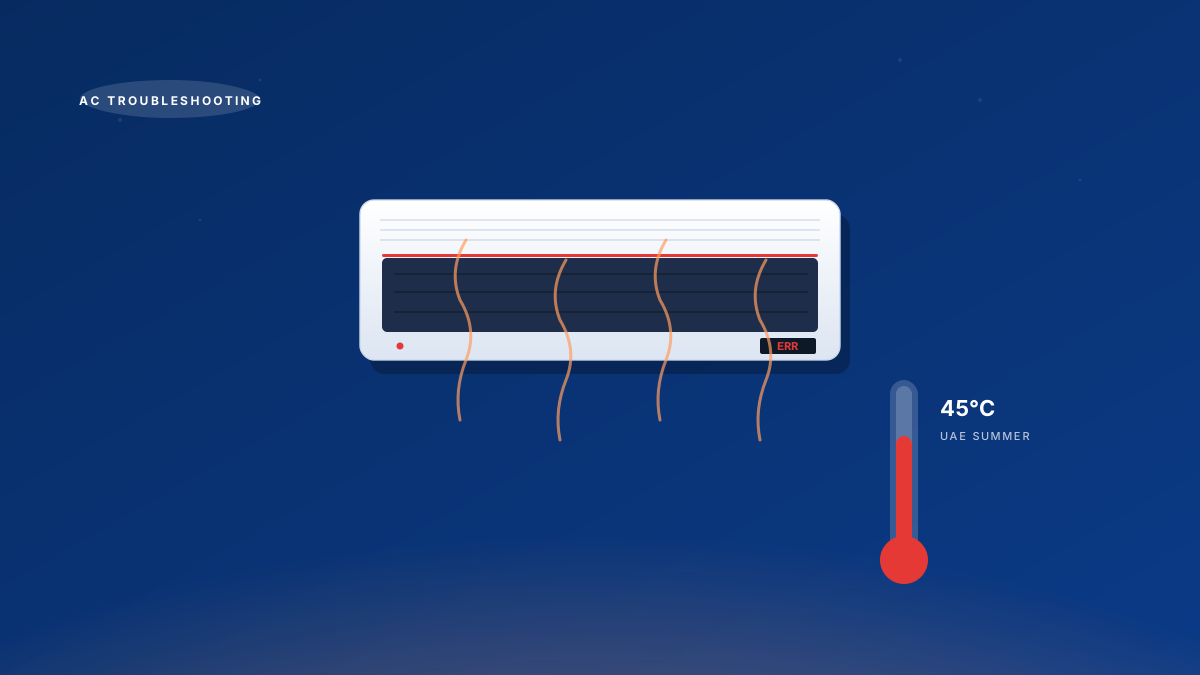
In most parts of the world a struggling air conditioner is an inconvenience. In the UAE, where July afternoons sit well above 45°C and even midnight rarely drops below 32°C, a failing AC is a genuine problem. It affects your comfort, your electricity bill, and in the worst cases your safety. The trouble is that air conditioners almost never break without warning. They tell you they’re in trouble days, sometimes weeks, before they quit completely.
After more than a decade running Smart AC Repair UAE across Sharjah and Dubai, our technicians have learned a simple truth: the customers who call early pay a fraction of what the customers who “waited to see if it sorted itself out” end up paying. A loose connection caught in May is a 20-minute fix. The same unit ignored until August is a burnt-out compressor and a four-figure invoice.
So here are the five warning signs we tell every UAE homeowner to watch for. If you spot even one of them, it’s worth booking a diagnostic visit before the heat does the deciding for you.
1. The air coming out is warm, or just not cold enough
This is the one nobody can ignore, and it’s usually the sign that something has already gone wrong rather than something that’s about to. If your vents are blowing room-temperature or only mildly cool air while the unit is clearly running, a few things could be happening at once.
The most common cause we see in the UAE is low refrigerant from a slow leak. Refrigerant is the fluid that actually carries heat out of your home, and it runs in a sealed loop. So if you’re low, you have a leak somewhere, full stop. Topping it up without finding the leak is throwing money away, and in the UAE refrigerant handling is restricted to licensed engineers for good reason: a careless recharge can wreck the compressor within months.
The other usual suspects are a failing compressor, a frozen evaporator coil (often caused by a dirty filter, ironically), or a condenser outside that’s so caked in dust it can no longer dump heat into the air.
Quick check first: before you call anyone, confirm the thermostat is on “cool” and set below room temperature, and that the filter isn’t a solid pillow of dust. We’ve attended callouts that turned out to be a filter that hadn’t been rinsed in a year. If a clean filter and correct settings don’t bring the cold air back within an hour, it’s a technician job.
2. Strange noises you’ve never heard before
A healthy split AC is almost boringly quiet. You should hear a soft, steady whoosh of air and a low hum from outside, nothing more. The moment that changes, your unit is telling you a part is working its way loose or wearing out.
- Grinding or screeching usually points to a fan motor bearing on its way out, or the motor running dry of lubrication.
- Banging or clanking often means a loose or broken part, such as a fan blade or a connecting rod inside the compressor, rattling around where it shouldn’t be.
- Rattling or buzzing can be something as minor as loose screws on the casing, or as serious as electrical components vibrating because a mounting has failed.
- Clicking that won’t stop when the unit tries to start is frequently a failing capacitor, the part that gives the compressor the jolt it needs to kick on.
The mistake people make is running the unit anyway because “it’s still cooling.” That’s exactly how a cheap part becomes an expensive one. A loose fan blade left to run will eventually shear off and take the motor with it. A clicking capacitor left alone will cook the compressor it keeps failing to start.
Switch it off if you hear grinding or banging. Continuing to run a unit making mechanical noise is the single fastest way to turn a small repair into a full motor or compressor replacement. Power it down and book a visit the same day.
3. Water leaking or pooling indoors
Your AC produces condensation, which is normal, and it’s supposed to drain away quietly through a pipe. When you start seeing water dripping from the indoor unit, pooling on the floor beneath it, or staining the ceiling below a ducted system, the drainage has failed.
In UAE homes the two usual causes are a blocked condensate drain line (dust, algae and grime build up and clog it, which is extremely common in our climate) and a frozen evaporator coil that’s dumping melt-water faster than the pan can handle once it thaws. Less often, it’s a cracked or overflowing drain pan.
This sign deserves urgency for a reason most people don’t think about: it’s rarely just an AC problem. Water sitting against ceilings and walls in a sealed, humid apartment leads to mould, ruined gypsum, and damage that costs far more than the repair itself. We’ve seen a blocked drain pipe, a 30-minute clear-out, left long enough to bring down a section of ceiling.
What to do right now: switch the unit off at the wall, place a towel or container to catch the drip, and call for service. Don’t keep running it, because you’re adding water to the problem with every minute it’s on.
4. Your DEWA, SEWA or FEWA bill has jumped for no reason
Your electricity bill is one of the most honest diagnostic tools you have, and almost nobody uses it. An AC that’s developing a fault doesn’t fail efficiently. It works harder and harder to deliver the same cooling, burning more power the whole time, often for weeks before you’d notice anything wrong with the cold air.
Compare this month’s bill to the same month last year. If consumption has climbed 15 to 30% with no change in how you’re using the place, meaning no new occupants, no thermostat set lower and no new appliances, your AC is the most likely culprit. The underlying faults are usually:
- Dirty coils and filters forcing the unit to run longer to hit temperature
- A failing capacitor making the compressor draw excess current on every start
- A slow refrigerant leak, where the unit runs almost continuously trying to compensate
- A condenser outside choked with sand after a season of dust storms
The encouraging part is that this is the cheapest sign to act on. A proper service (coil clean, filter, gas pressure check, capacitor test) often pays for itself in a single summer of recovered efficiency, quite apart from preventing the breakdown the rising bill is warning you about.
5. The unit keeps switching itself on and off
If your AC turns on, runs for a couple of minutes, shuts down, then starts again a few minutes later, over and over, that’s called short-cycling, and it’s hard on the most expensive part of the whole system. A healthy unit in a UAE summer should run in steady stretches of 15 to 30 minutes, not in nervous little bursts.
Short-cycling has a handful of common causes: a faulty thermostat misreading the room temperature, a clogged filter triggering the unit’s safety cut-out, a refrigerant problem, or an electrical fault. Occasionally it’s a unit that was simply oversized for the room when it was installed, so it cools too fast, shuts off, and the cycle repeats.
Whatever the cause, the damage is the same. Every start-up is the heaviest moment of load on a compressor, and a unit that’s starting ten times an hour instead of twice is ageing at a brutal rate. Short-cycling is one of the clearest “fix me before I die” signals an AC can give, and it’s almost always cheaper to address the cause than to replace the compressor it’s wearing out.
Why catching these early matters so much in the UAE
In a cooler climate, a struggling AC can limp along for weeks while you decide what to do. Here it can’t, and neither can you. When an AC fails in a Dubai or Sharjah summer, indoor temperatures can climb past 35°C within a couple of hours. That’s uncomfortable for healthy adults and genuinely dangerous for infants, elderly residents, and anyone with a heart or respiratory condition.
There’s also the simple economics of it. The faults behind these five signs, whether a capacitor, a fan bearing, a blocked drain, a refrigerant leak or a dirty coil, are inexpensive and quick when they’re caught in spring. Left until peak summer, they cascade. A failing capacitor takes out a compressor. A blocked drain rots a ceiling. A small leak runs the unit into the ground. The customers who pay the most are almost always the ones who heard the noise, saw the bill, or felt the warm air and decided to wait.
If you want to get ahead of all five, the single best habit is a twice-yearly service: once before summer in April or May, and once after in October. We explain exactly why and what’s involved in our guide to how often you should service your AC in the UAE. And if your unit has already stopped cooling, our breakdown of why your AC isn’t cooling in UAE summer walks through the checks worth doing first.
Frequently asked questions
How quickly can you get a technician out?
We run same-day service across Sharjah and Dubai, with average arrival times of around 45 minutes in Dubai and 60 minutes in Sharjah. For urgent cases such as water leaking indoors, a burning smell, or no cooling with infants or elderly at home, message our dispatch team on WhatsApp and we’ll prioritise the call.
Is it cheaper to repair my AC or replace it?
A useful rule of thumb: if the repair costs more than half the price of an equivalent new unit and your AC is over 8 years old, replacing it usually makes more sense, because a modern inverter unit pays back the difference in DEWA savings within two to three years. Under that threshold, repair almost always wins. We’ll give you both options with honest pricing rather than pushing the bigger job.
Can I top up the refrigerant gas myself?
No. Refrigerant handling in the UAE must be done by a licensed engineer, and for good reason. It needs proper gauges and vacuum equipment to do safely, and a botched recharge can destroy the compressor. More importantly, low gas always means a leak, so the real fix is finding and sealing the leak first, then recharging.
My AC still cools a bit, can I wait until the weekend?
If you’re hearing grinding or banging, seeing water indoors, or smelling anything burning, then no, switch it off now. Running a unit through a mechanical or electrical fault is exactly how a small repair becomes a compressor replacement. If it’s just slightly weaker cooling or a higher bill with no other symptoms, a day or two is fine, but don’t let it drift into peak summer.
Do you service all AC brands?
Yes. We service O General, Daikin, LG, Samsung, Carrier, Gree, Mitsubishi, Trane and every other brand commonly installed in the UAE, across both split and ducted systems. Our technicians carry parts for the most common models, so many repairs are completed in a single visit.
Book a same-day AC technician
If your AC is showing any of these five signs, the cheapest and safest move is to have it looked at now, not in the middle of a 48°C week when every repair company in the city is booked solid. Our AC repair and maintenance team works across Sharjah and Dubai, with licensed technicians, transparent pricing and a 90-day workmanship warranty on every repair.
Need this repair? We cover your city
Related reading
How Often Should You Service Your AC in the UAE?
The honest UAE answer: twice a year, and we'll tell you exactly when. A practical guide to AC service frequency from technicians who run…
AC Gas Refill UAE: Cost, Signs & When You Need It
AC not cooling and someone told you it needs gas? Here is what an AC gas refill really involves in the UAE, the signs…
Why Your AC Isn’t Cooling in UAE Summer: Causes & Fixes
AC blowing warm air in 45°C heat? Six common causes our UAE technicians see daily, plus what you can check yourself before calling a…