
Oven Not Heating Evenly? Common Causes Explained
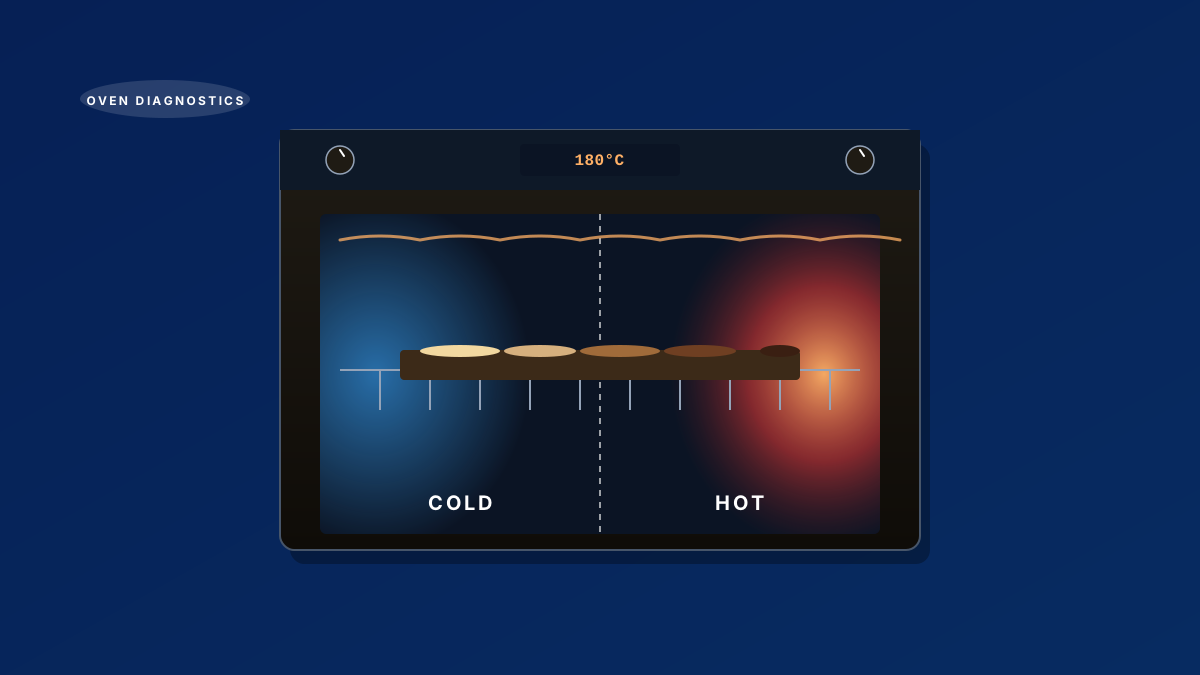
You pull a tray of biscuits out of the oven and the ones at the back are crisp and golden while the ones at the front are still pale and soft. Or a roast that’s overdone on one side and pink in the middle. If this sounds familiar, you’re not imagining it – your oven is heating unevenly, and there are five common reasons why.
The good news: two of these you can check yourself, and three are straightforward technician fixes.
How a UAE oven should heat
A working oven – gas, electric, or convection – should reach the set temperature within 15 minutes and hold it within ±5°C across the cavity. If you put a thermometer on the top rack and another on the bottom, they should agree within that tolerance.
When that breaks down, food cooks unevenly. The science is straightforward: heat is generated by elements (electric) or burners (gas), distributed by natural convection or a fan, and held by insulation and a sealed door. A failure in any of those four stages causes uneven baking.
1. Faulty heating element
Electric ovens have two main elements:
- Bake element – at the bottom of the cavity, the larger one
- Broil / Grill element – at the top, often used for browning
If one element fails, the oven still heats – just from the other one. That’s why uneven heating is often the first sign of a dead element, not a complete failure.
How to tell which element is the problem:
- Set the oven to 180°C, bake mode
- Wait 15 minutes
- Hold your palm 30cm below the top element (carefully – the cavity is hot)
- Then 30cm above the bottom element
- Both should radiate similar heat
A visibly damaged element – bulged spots, dark patches, or one that doesn’t glow red – needs replacement.
In gas ovens, the equivalent is a partially blocked burner. The flame should be steady and blue across the full burner. Yellow flames or gaps in the flame pattern mean a clog.
Safety first. Don’t try to replace an electric oven element while it’s plugged in. Switch off at the breaker. And never work on a gas oven burner yourself – gas connections require certified technicians in the UAE.
2. Thermostat reading wrong
The oven thermostat is the sensor that tells the control board when to turn elements on and off. As it ages, it can drift – usually reading higher than actual, so the oven shuts off elements before the cavity is hot enough.
Symptoms of a drifted thermostat:
- Food consistently underdone despite the correct temperature setting
- Long preheating times (over 20 minutes for a 200°C set point)
- Some recipes that used to work no longer do
- A small dial-style temperature knob feels loose or worn
How to test at home:
- Place an oven thermometer in the centre of the middle rack
- Set the oven to 180°C
- Wait 25 minutes for the temperature to stabilise
- Read the thermometer
If the reading is more than 15°C off (in either direction), the thermostat needs recalibrating or replacing.
For a small offset (under 25°C), you can sometimes work around it by adjusting recipes. For larger drift, replacement is the right answer.
3. Convection fan not working (fan-assisted ovens)
Modern UAE kitchens almost always have a convection or fan-assisted oven. A small fan at the back circulates hot air, keeping temperature even across all racks. When that fan slows or stops, the oven reverts to natural convection – hot air rising, cool air sinking – and you get the classic uneven heating.
Listen for the fan when the oven is at temperature: it should be audible but not loud. If it’s silent in convection mode, the motor or its capacitor has failed.
Other signs:
- Top racks browning much faster than bottom
- Single-tray cooking works but multi-tray doesn’t
- Strong heat near the back of the cavity, cool at the front
Fan replacement is typically a 45–60 minute job for a technician with the right parts. The fan motor itself runs AED 250–500 depending on brand.
4. Calibration drift
Even with all components healthy, an oven’s temperature display can drift over time. The control board’s reference point shifts by a few degrees each year – small enough you don’t notice for the first 5 years, big enough to ruin baking after 8.
The fix is recalibration, not replacement. Modern ovens (Bosch, Miele, Siemens, Samsung, LG) have a service mode that lets a technician adjust the reference point so the display matches the actual cavity temperature again.
If you bake regularly and care about precision, request a calibration check every 3–4 years. It’s a 30-minute visit and dramatically extends the useful life of the oven.
5. Compromised door seal
This is the one most homeowners miss. The oven door has a rubber or silicone gasket that seals heat inside the cavity. As that seal hardens, cracks or shrinks (UAE heat accelerates this), heat escapes around the door.
You’ll notice:
- The kitchen feels noticeably hotter when the oven is running
- The oven works harder to maintain temperature (your DEWA bill creeps up)
- Front of the food cooks slower than the back
- The handle gets hot enough to be uncomfortable
Check by closing the door on a slip of paper – you should feel resistance pulling it out. If it slides out easily, the seal needs replacing. New seals are inexpensive and a 30-minute job.
Quick homeowner checks before calling
Before booking a technician, try these:
- Rotate trays mid-bake – if rotation fixes the unevenness, the fan or elements are the issue, not your technique.
- Use an oven thermometer – confirms whether the display matches reality.
- Inspect the seal visually – look for hardening, cracks or gaps.
- Listen for the fan – should run continuously in convection mode.
- Check for blocked vents – some UAE built-in ovens have rear or top vents that get blocked by cabinet installation.
If two or more of these point to a problem, it’s time for a professional diagnosis.
When to call a technician
- Element shows visible damage
- Fan is silent in convection mode
- Thermostat is off by more than 20°C
- Door seal is cracked or sliding paper out easily
- Burning smell (electrical or gas)
- Inconsistent baking even after rotating trays
Most uneven-heating callouts are resolved in a single visit. Common parts (elements, fan motors, thermostats, seals) are kept on the van for major UAE brands.
Maintenance to prevent uneven heating
A few habits keep ovens cooking evenly for years longer:
- Don’t line the bottom with foil – it disrupts heat distribution and damages the element
- Wipe spills the same day – burnt-on food affects sensors and elements
- Use the cleaning cycle quarterly – burns off residue that would otherwise affect heating
- Don’t slam the door – repeated impact loosens the seal
- Get an annual inspection if you bake regularly – catches drift before it ruins a recipe
Frequently asked questions
Should the top and bottom of my oven feel the same temperature?
In a healthy convection oven, yes – within 5°C. In a non-convection oven, the top will be slightly hotter than the bottom.
Why does my oven take so long to preheat?
Either the thermostat is drifted (the element runs longer than it should) or the element is partially failed. An oven thermometer tells you which.
Can I use my oven if one element is broken?
Technically yes, but cooking will be very uneven and energy use goes up. Best to replace the element promptly.
Is it worth repairing an old oven?
For built-in ovens (Bosch, Miele, Siemens), yes – replacement requires kitchen rework. For freestanding ovens over 8 years old, compare repair cost to a new equivalent.
Do you repair imported or specialty ovens?
Yes – we service Miele, Bosch, Siemens, Smeg, AEG, Wolf, Sub-Zero and most UAE-imported brands. Some parts may need ordering for very specialised models.
Need this repair? We cover your city
Related reading
Refrigerator Compressor Problems: Causes, Fixes and When to Replace
Refrigerator compressor problems explained - why fridges stop cooling, the noises to watch for, what you can safely check yourself, and when to repair…
Oven Temperature Wrong or Not Accurate? Causes and Fixes
Oven running too hot or too cold, burning or undercooking food? The common causes, how to test the real temperature, DIY fixes, and when…
Dishwasher Not Cleaning Dishes Properly? Here Is Why
Dishwasher leaving dishes dirty, gritty or filmy? The common causes - clogged spray arms, hard-water scale, loading mistakes - plus DIY fixes and when…